
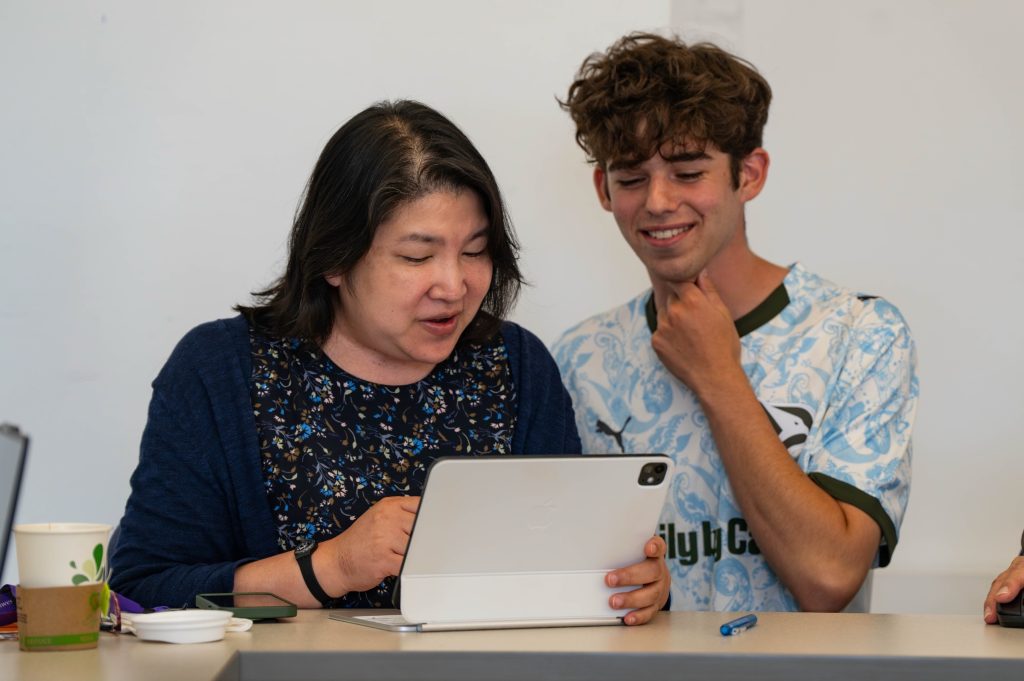
The first time students received instructor feedback on their writing assignments, many were taken aback.
“I was shocked because there wasn’t a single positive comment,” Ashlyn Wong of Belmont, California, said. “This was the first time I’d ever experienced this, and it was scary because I was pretty confident in my journalism.”
Although initially jarring, students quickly found their footing, incorporating the constructive criticism to strengthen their writing.
“I liked how my instructor’s feedback wasn’t specific to just grammar, but it was ‘You need to expand more on this’ or ‘You need to highlight this point of view more,’” Wong said.
The emphasis on practical, detailed feedback was echoed by other students.
“My instructor is a real stickler of repeated words or phrases,” Arden Li of Highland Park, New Jersey, said. “Also, structure, style and clarity. She wants you to have some fun with writing, but also to be very straightforward at the same time.”
Instructor Peter Slevin said feedback focuses on helping students think like journalists instead of simply correcting mistakes.
“Is the article clear? Is it understandable? And then, along the way, does it flow smoothly? Would a reader understand what the story is about?” Slevin said.
Many students also appreciated that they were not given grades on their assignments.
“The no-grade philosophy makes you more confident to take chances in your writing,” Emily Hauck of Watchung, New Jersey, said. “It helps you focus more on what you can improve instead of just trying to get a higher number each time.”
Slevin said the instructor editing process and no-grade philosophy revolves around helping students grow and gain more individual agency.
“We want students to feel free to experiment, learn and not be cautious because they were afraid,” Slevin said.
